
• Sunrise At: 5:14 AM
  • Sunset At: 7:35 PM

Today's Prayer Times

8th Ramadan, 1447 - - Sydney, Australia

  • Fajr 5:15 AM Iqamah:
  • Sunrise 6:42 AM Iqamah:
  • Zuhr 1:08 PM Iqamah:
  • Sunset 7:34 PM Iqamah:
  • Magrib 7:54 PM Iqamah:
  • Jumah Zuhr time Iqamah: 12:00 PM

Welcome To Muhammadi Welfare Association

Community Center for all

Learn More

MUHAMMADI WELFARE ASSOCIATION INC was founded in 1989 by a group of professionals and university students in Australia. It is an independent initiative whose long term aspirations centre on the preparation for the blessed return of the Saviour, Imam Al-Mahdi (atf).

The best of you in the sight of Allah (s.w.t.) is the most righteous of you.

Surah Al-Hujurat

(49:13)

Recent News & Updates

Comments Box SVG iconsUsed for the like, share, comment, and reaction icons

... See MoreSee Less

21 hours ago
*Seventh Juz - Summary*
7th Juz Audio file link: https://tinyurl.com/5xv8wm9h

This Juz consists of two parts:
1. The remainder of Surah Al-Ma’idah
2. The beginning of Surah Al-An’am

First Part: The Remainder of Surah Al-Ma’idah
This section covers four main themes:
1. Praise of the Christians of Abyssinia
• When they hear the Quran, their eyes fill with tears.
• Their sincere faith and emotional response to Allah’s verses are described.
2. Refutation of a False Standard and a Lesson on Obedience
• Being in the majority does not guarantee truth.
• Prophets’ humility before Allah is emphasized (Surah Ma’idah, Verse 109).
3. Rules about Halal and Haram
• People should not decide for themselves what is halal or haram.
• Asceticism (giving up worldly desires) is discouraged in Islam.
• A foolish oath is not held accountable, but a false oath requires expiation:
o Feeding ten needy people, or
o Clothing them, or
o Freeing a slave, or
o If none of these are possible, fasting for three days.
• Prohibited actions:
o Alcohol, gambling, idol worship, and divining arrows.
• Rules for the state of Ihram:
o Hunting is forbidden, but fishing is allowed.
• Sanctity of the Haram (Ka’bah):
o Whoever enters the sacred precincts is granted safety.
• Abolition of pagan customs:
o The Qur’an forbids certain animals designated by polytheists as sacred (e.g., Bahirah, Saibah, Wasilah, and Ham).
4. The Day of Judgment and Mention of Prophet Isa (Jesus)
• On the Day of Judgment, prophets will be asked about the response of their people.
• Allah will remind Prophet Isa of His blessings upon him:
o The Heavenly Table (Ma’idah) was sent down upon his disciples.
o He performed miracles like healing the sick and reviving the dead.
• Allah will ask Prophet Isa:
o Did you tell people to worship you and your mother?
o Prophet Isa will swear that he only invited people to worship Allah alone.

Second Part: The Beginning of Surah Al-An’am
This section includes four main themes:
1. Tawheed – The Oneness of Allah
• The Surah elaborates on Allah’s greatness, power, and sovereignty.
• Allah is the Creator and the ultimate authority over everything.
2. Messengership – The Role of Prophets
• People questioned why the Prophet Muhammad ﷺ was a human and not an angel.
• Allah clarifies that prophets are human so that they can serve as practical role models.
• The mission of Prophet Muhammad ﷺ is for all of humanity.
• Mention of 18 Prophets in this Surah:
1. Ibrahim،Ishaq،Yaqub۔Nuh۔ Dawood۔ Sulayman۔ Ayyub۔Yusuf، Musa۔ Haroon۔ Zakariy، Yahya، Isa، Ilyas، Ismail،Al-Yasa’۔Yunus۔ Lut۔ 
• Prophet Ibrahim’s father was Tarukh, but the Qur’an refers to his uncle Azar as his father in the sense of a guardian.
3. The Day of Judgment – Reality of the Hereafter
• Key verses about the Day of Judgment: (Surah An’am: 12, 16, 22, 27, 32)
• People will be gathered before Allah for judgment.
• The disbelievers will regret their choices and wish they could return to the world to accept faith.
4. Ethical and Moral Guidelines
• Avoid gatherings where Allah’s signs are mocked, except when done for the purpose of admonition.
• Cursing and foul language are forbidden, even against enemies, to prevent disrespect towards Allah.

This quiz includes important questions related to the themes of the  7th Juz of the Holy Quran, with the audio link serving as a helpful aid in understanding them.  https://tinyurl.com/mvkbwrahImage attachment

*Seventh Juz' - Summary*
7th Juz Audio file link: tinyurl.com/5xv8wm9h

This Juz' consists of two parts:
1. The remainder of Surah Al-Ma’idah
2. The beginning of Surah Al-An’am

First Part: The Remainder of Surah Al-Ma’idah
This section covers four main themes:
1. Praise of the Christians of Abyssinia
• When they hear the Quran, their eyes fill with tears.
• Their sincere faith and emotional response to Allah’s verses are described.
2. Refutation of a False Standard and a Lesson on Obedience
• Being in the majority does not guarantee truth.
• Prophets’ humility before Allah is emphasized (Surah Ma’idah, Verse 109).
3. Rules about Halal and Haram
• People should not decide for themselves what is halal or haram.
• Asceticism (giving up worldly desires) is discouraged in Islam.
• A foolish oath is not held accountable, but a false oath requires expiation:
o Feeding ten needy people, or
o Clothing them, or
o Freeing a slave, or
o If none of these are possible, fasting for three days.
• Prohibited actions:
o Alcohol, gambling, idol worship, and divining arrows.
• Rules for the state of Ihram:
o Hunting is forbidden, but fishing is allowed.
• Sanctity of the Haram (Ka’bah):
o Whoever enters the sacred precincts is granted safety.
• Abolition of pagan customs:
o The Qur’an forbids certain animals designated by polytheists as sacred (e.g., Bahirah, Sa'ibah, Wasilah, and Ham).
4. The Day of Judgment and Mention of Prophet Isa (Jesus)
• On the Day of Judgment, prophets will be asked about the response of their people.
• Allah will remind Prophet Isa of His blessings upon him:
o The Heavenly Table (Ma’idah) was sent down upon his disciples.
o He performed miracles like healing the sick and reviving the dead.
• Allah will ask Prophet Isa:
o "Did you tell people to worship you and your mother?"
o Prophet Isa will swear that he only invited people to worship Allah alone.

Second Part: The Beginning of Surah Al-An’am
This section includes four main themes:
1. Tawheed – The Oneness of Allah
• The Surah elaborates on Allah’s greatness, power, and sovereignty.
• Allah is the Creator and the ultimate authority over everything.
2. Messengership – The Role of Prophets
• People questioned why the Prophet Muhammad ﷺ was a human and not an angel.
• Allah clarifies that prophets are human so that they can serve as practical role models.
• The mission of Prophet Muhammad ﷺ is for all of humanity.
• Mention of 18 Prophets in this Surah:
1. Ibrahim،Ishaq،Yaqub۔Nuh۔ Dawood۔ Sulayman۔ Ayyub۔Yusuf، Musa۔ Haroon۔ Zakariy، Yahya، Isa، Ilyas، Ismail،Al-Yasa’۔Yunus۔ Lut۔
• Prophet Ibrahim’s father was Tarukh, but the Qur’an refers to his uncle Azar as his "father" in the sense of a guardian.
3. The Day of Judgment – Reality of the Hereafter
• Key verses about the Day of Judgment: (Surah An’am: 12, 16, 22, 27, 32)
• People will be gathered before Allah for judgment.
• The disbelievers will regret their choices and wish they could return to the world to accept faith.
4. Ethical and Moral Guidelines
• Avoid gatherings where Allah’s signs are mocked, except when done for the purpose of admonition.
• Cursing and foul language are forbidden, even against enemies, to prevent disrespect towards Allah.

This quiz includes important questions related to the themes of the 7th Juz of the Holy Quran, with the audio link serving as a helpful aid in understanding them. tinyurl.com/mvkbwrah
... See MoreSee Less

1 day ago
Assalam O Alaykum,

It is with deep sadness to inform you that Marhooma Zainab Begum Binte  Syed Farzand Hussain, passed away earlier today in Karachi.

Marhooma was mother of Sister Saima Saeed.

Please recite Surah Fateha and namaz e wehshat e Qabr (tonight after 7 PM Sydney time) and remember Marhooma in your duas and pray that Allah may grant her an exalted place in Jannah, and sabr-e-Jamel to the family members.

Thank you,

Muhammadi Welfare Association

Assalam O Alaykum,

It is with deep sadness to inform you that Marhooma Zainab Begum Binte Syed Farzand Hussain, passed away earlier today in Karachi.

Marhooma was mother of Sister Saima Saeed.

Please recite Surah Fateha and namaz e wehshat e Qabr (tonight after 7 PM Sydney time) and remember Marhooma in your duas and pray that Allah may grant her an exalted place in Jannah, and sabr-e-Jamel to the family members.

Thank you,

Muhammadi Welfare Association
... See MoreSee Less

2 days ago
*Summary of the Sixth Juz (English)*
“Audio link” https://tinyurl.com/sfmsrvr3

This Juz consists of two parts:
1. The remainder of Surah Nisa
2. The beginning of Surah Maida
First Part: The Remainder of Surah Nisa
This section contains four major topics:
1. Exception to the prohibition of backbiting: Raising voices for the oppressed
o It is allowed for the oppressed to speak against their oppressors.
o Scholars consider this an exception to the general rule of backbiting.
2. Condemnation of the Jews
o They attempted to kill Prophet Isa (Jesus), but Allah saved him.
3. Condemnation of the Christians
o Christians exaggerated the status of Prophet Isa and created the doctrine of Trinity.
4. Inheritance Laws Explained Further
o A single sister gets half the inheritance.
o Two or more sisters get two-thirds (2/3).
o If they have brothers, each brother gets double the share of a sister.
________________________________________
Second Part: Beginning of Surah Maida
This section discusses seven main topics:
1. Honoring Contracts
o Every valid contract and oath made with Allah or people must be fulfilled.
2. Forbidden Items
o Flowing blood, pork, and anything slaughtered in the name of other than Allah.
o The religion is completed (through the declaration of Imam Alis Wilayah).
3. Rules of Purification (Taharah)
o The rules of Wudu, Tayammum, and Ghusl are explained.
4. Reference to the Twelve Chiefs of Bani Israel
o Imam Ahmad bin Hanbal mentioned in his Musnad that this refers to the 12 Imams.
5. The Story of Habil and Qabil
o Qabil killed Habil, and this is used to explain laws of murder and theft.
6. Verse of Wilayah
o Your guardian is only Allah, His Apostle, and those who establish prayer and give zakat while bowing down. (Maida 5:55)
o Many commentators agree that this refers to Imam Ali.
o The Prophet was commanded to declare Imam Alis authority.
7. Condemnation of Jews and Christians
o They falsely claim to be Allah’s children, yet they were punished by Him.
o Allah consoled the Prophet for the difficulties caused by them.
o Muslims were instructed not to take them as close friends.
o The literal cursing of Jews and Christians by Prophets Isa and Dawood is mentioned.

Quiz : https://tinyurl.com/365n9v5rImage attachment

*Summary of the Sixth Juz (English)*
“Audio link” tinyurl.com/sfmsrvr3

This Juz consists of two parts:
1. The remainder of Surah Nisa
2. The beginning of Surah Maida
First Part: The Remainder of Surah Nisa
This section contains four major topics:
1. Exception to the prohibition of backbiting: Raising voices for the oppressed
o It is allowed for the oppressed to speak against their oppressors.
o Scholars consider this an exception to the general rule of backbiting.
2. Condemnation of the Jews
o They attempted to kill Prophet Isa (Jesus), but Allah saved him.
3. Condemnation of the Christians
o Christians exaggerated the status of Prophet Isa and created the doctrine of Trinity.
4. Inheritance Laws Explained Further
o A single sister gets half the inheritance.
o Two or more sisters get two-thirds (2/3).
o If they have brothers, each brother gets double the share of a sister.
________________________________________
Second Part: Beginning of Surah Maida
This section discusses seven main topics:
1. Honoring Contracts
o Every valid contract and oath made with Allah or people must be fulfilled.
2. Forbidden Items
o Flowing blood, pork, and anything slaughtered in the name of other than Allah.
o The religion is completed (through the declaration of Imam Ali's Wilayah).
3. Rules of Purification (Taharah)
o The rules of Wudu, Tayammum, and Ghusl are explained.
4. Reference to the Twelve Chiefs of Bani Israel
o Imam Ahmad bin Hanbal mentioned in his "Musnad" that this refers to the 12 Imams.
5. The Story of Habil and Qabil
o Qabil killed Habil, and this is used to explain laws of murder and theft.
6. Verse of Wilayah
o "Your guardian is only Allah, His Apostle, and those who establish prayer and give zakat while bowing down." (Maida 5:55)
o Many commentators agree that this refers to Imam Ali.
o The Prophet was commanded to declare Imam Ali's authority.
7. Condemnation of Jews and Christians
o They falsely claim to be Allah’s children, yet they were punished by Him.
o Allah consoled the Prophet for the difficulties caused by them.
o Muslims were instructed not to take them as close friends.
o The literal cursing of Jews and Christians by Prophets Isa and Dawood is mentioned.

Quiz : tinyurl.com/365n9v5r
... See MoreSee Less

2 days ago

... See MoreSee Less

3 days ago
Load more

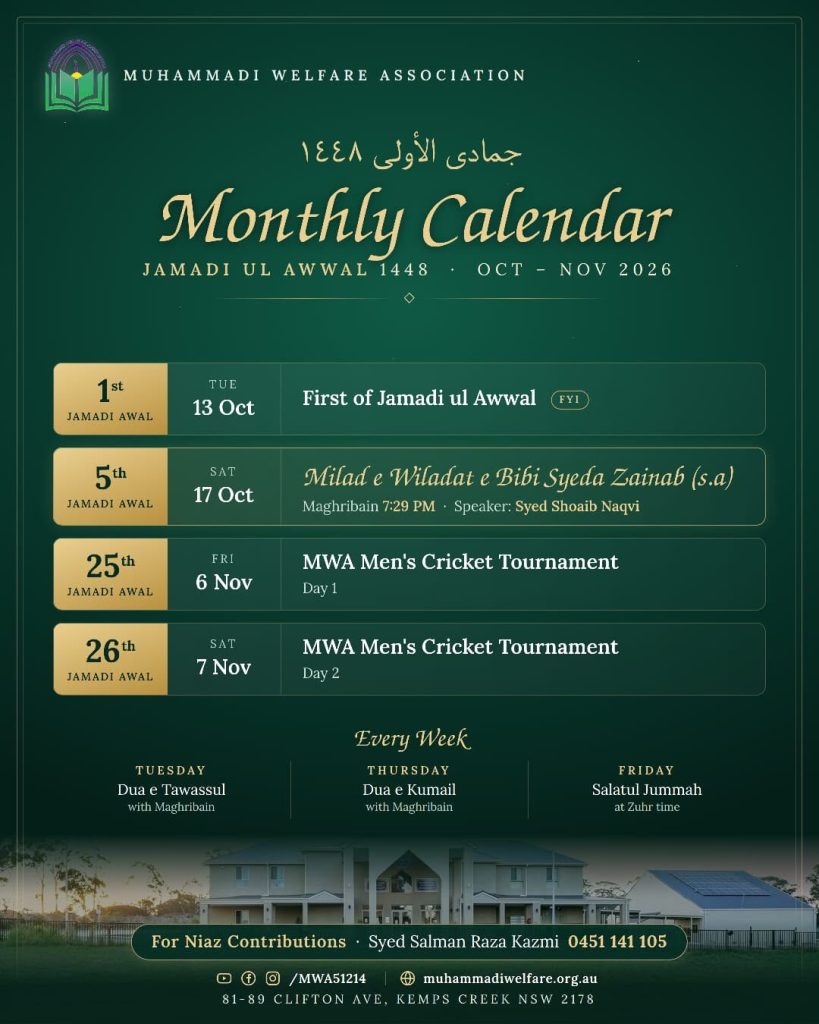
MONTHLY CALENDER

Services We Offer

MWA Services for community

Counselling

MWA offer counselling to it's community members.

Read More

Community Support

MWA has become aware of members of the...

Read More

Cemetery Services

We are pleased to inform you that Alhamdulillah,...

Read More

Community school

MWA has arranged Community Language School for the...

Read More

Recent News & Updates

Adipiscing elit duis volutpat ligula nulla dapibus.

ACCOUNT NAME: Muhammadi Welfare

BSB : 062471

ACCOUNT NUMBER : 10242515

BANK: Commonwealth Bank of Australia

Copyright 2020, All Rights Reserved